How to Show Your Work Without Boring Your Clients
Key Takeaways
Dumping endless uncontextualized project images onto a portfolio page reduces your high-level service to a generic commodity.
Prospective clients don't just buy visual aesthetics; they buy the strategic problem-solving and expertise behind the finished result.
Structuring your portfolio around a narrative framework—Problem → Strategy → Solution → Result—clearly demonstrates business impact.
Elevating your case studies with clear context reassures high-intent prospects and transforms your prices into an easy, confident investment.
A well-architected case study acts as a silent sales representative, qualifying leads and setting expectations before your initial discovery call.
If you are a photographer, architect, designer, consultant, or agency owner, your portfolio is the beating heart of your website. It is where potential clients go to judge your craft, weigh your capabilities, and decide whether you are worth your rates.
Yet, a common pitfall across creative and professional services is treating a portfolio like a photo gallery.
Many business owners upload dozens of high-resolution images, add a brief title, and call it a day. While visually appealing, this approach forces your prospective client to do the heavy lifting. They are left guessing what challenges you faced, why you made specific choices, and what tangible value you actually created.
When you only show the final image without the context, you invite clients to judge you strictly on style rather than strategy—making your pricing feel arbitrary.
To build true market authority and justify premium rates, you must transform your portfolio from a passive photo gallery into an engaging narrative engine using Case Study Architecture.

It Invites Subjective Critique: When visitors only see a finished aesthetic, their reaction is purely emotional ("I like this color" or "This isn't my style") rather than strategic ("They solved a complex problem efficiently").
It Hides Your True Competence: The real magic of professional work often happens behind the scenes—navigating tricky client constraints, untangling technical hurdles, and refining drafts. Leaving out that journey hides your core value.
It Misses the Business Impact: Clients hire professionals to achieve an outcome, whether that's increasing revenue, elevating brand perception, or streamlining operations. Images alone cannot communicate results.
The 4-Part Case Study Framework
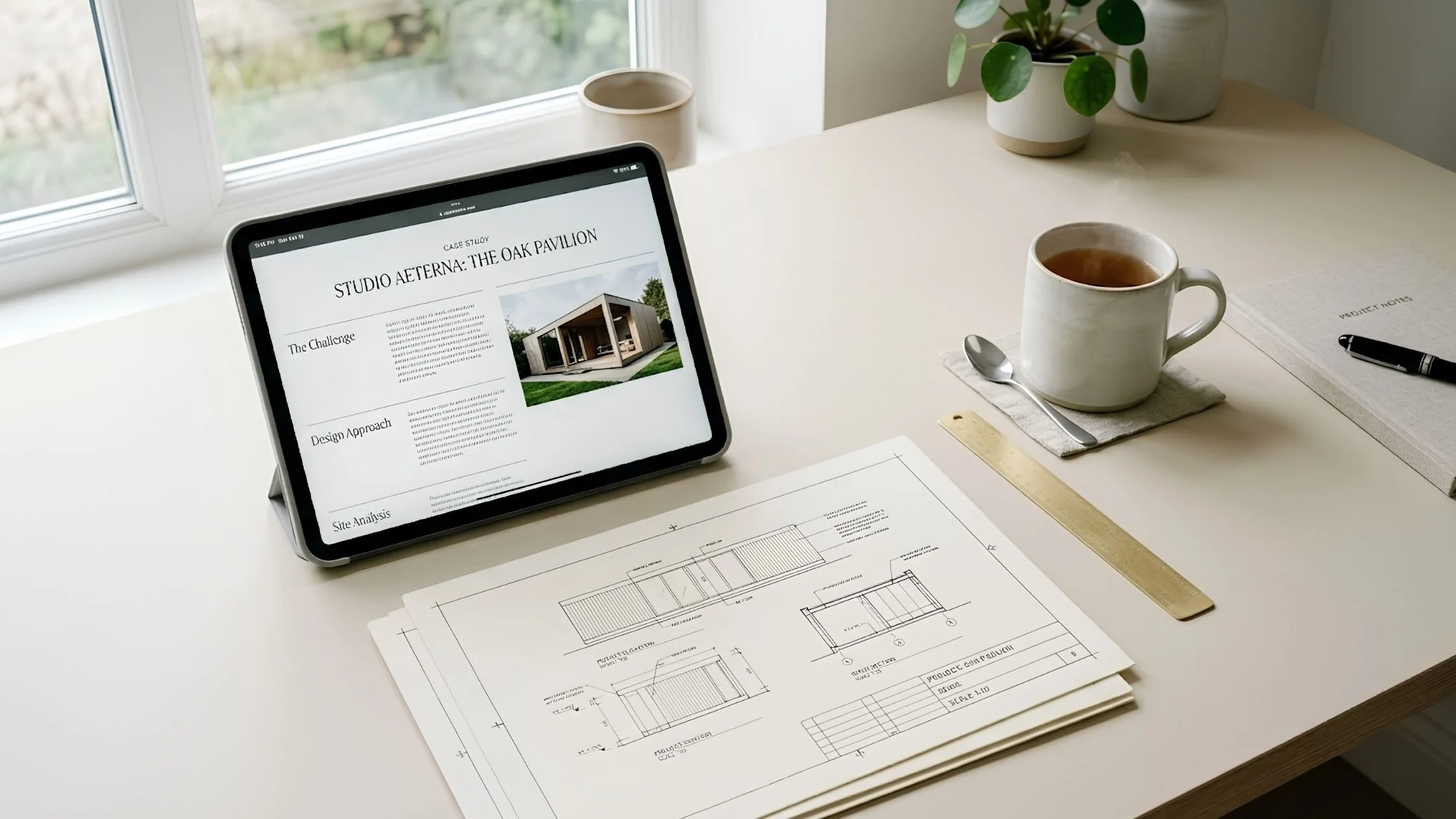
Structuring an impactful case study does not mean writing a novel. It means organizing your project story into a crisp, scannable, four-part framework:
1. The Problem (The Starting Point)
Begin by establishing the context. What specific challenge, goal, or limitation was the client facing before they hired you? Setting the stage allows prospective clients with similar problems to immediately identify with the project.
2. The Strategy (The Strategic Thinking)
Detail your approach. Why did you choose this specific path over alternatives? What insights guided your decisions? This section highlights your authority, proving that your decisions are grounded in expertise rather than random preference.
3. The Solution (The Execution)
Show the final deliverables in action. Pair your high-resolution visuals, layouts, or campaign assets with short, insightful captions explaining why key elements were designed or implemented the way they were.
4. The Result (The Business Impact)
Conclude with the outcome. Did the client launch successfully, increase conversions, streamline operations, or elevate their market standing? Whenever possible, include quantitative metrics alongside qualitative feedback or client testimonials.
FAQs
Do I need to write long case studies for every project in my portfolio?
Not at all. It is far better to feature 3 to 5 deeply articulated, narrative-driven case studies than 20 uncontextualized image dumps. Quality and depth will always build more trust than sheer volume.
What if I don't have hard revenue numbers or data metrics for the "Result" section?
Quantitative data is great, but qualitative results are equally powerful. A compelling quote from the client about how the project transformed their business confidence, saved them time, or elevated their reputation serves as a fantastic proof point.
How long should a standard case study be?
Keep it concise and scannable. Aim for 300 to 600 words structured with clear subheadings, bullet points, and high-impact visuals so time-strapped clients can grasp the full story in under two minutes.

Final thoughts
Your work is far more than a collection of pretty final outputs; it is the culmination of strategy, skill, and strategic problem-solving.
By applying clear case study architecture, you give your prospective clients the exact context they need to appreciate your expertise. You stop competing as a replaceable commodity and start standing out as an indispensable strategic partner.
What to do next
Select one of your favorite past projects this week. Instead of just displaying the final images, draft a brief narrative following the Problem → Strategy → Solution → Result model.
→ Download our Free Web Design Checklist to evaluate your portfolio layout, check your visual spacing, and streamline your case study presentation.
If you are ready to design a strategy-first, editorial website that presents your work with quiet authority, we are here to support your vision.
→ Access The Brand Clarity Coach AI to refine your project narratives, map out your service positioning, and clarify your platform goals 24/7—then get in touch with us to discuss your web design project.
This article was written with the help of The Brand Clarity Coach — an AI assistant created by Teresanne O’Reilly to help business owners and marketers define their brand strategy, sharpen their message, and create content that connects with their ideal customers.
Use The Brand Clarity Coach in your own business. Get instant lifetime access here for just €89.
You Might Also Like